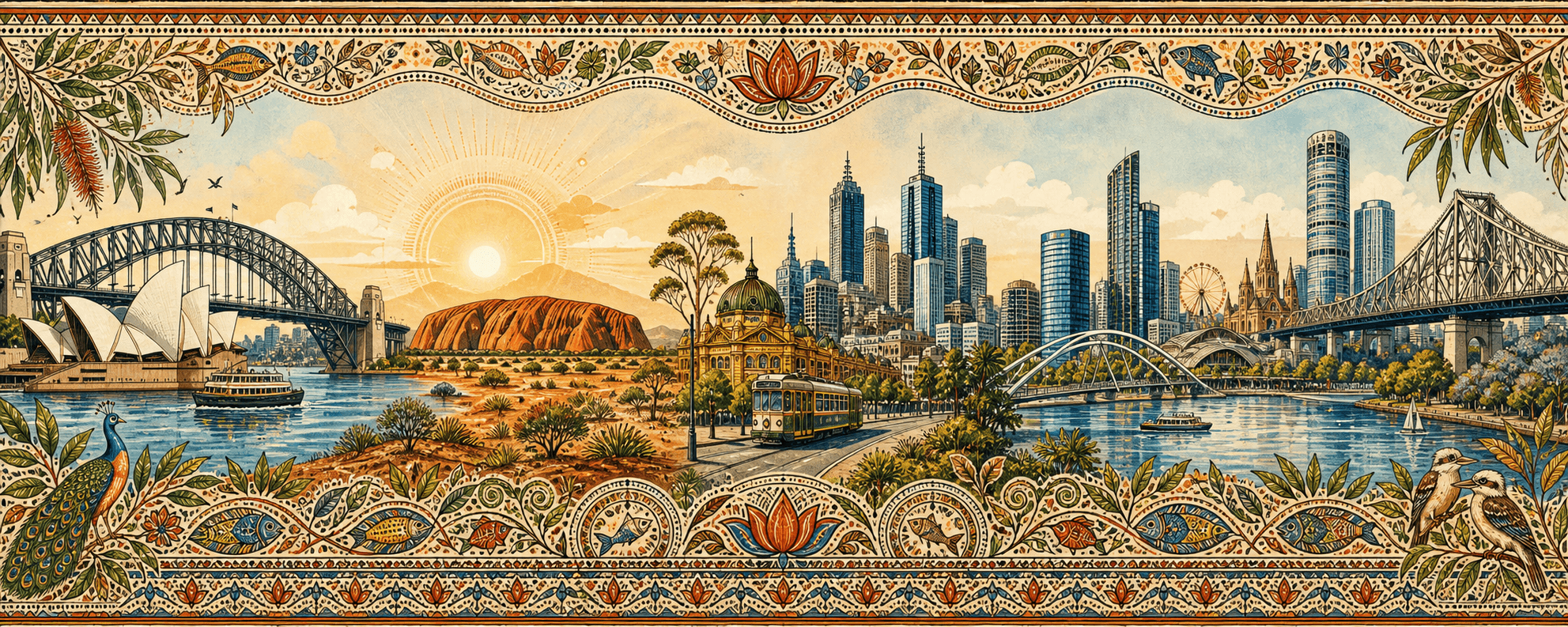
Australian landmarks with Mithila inspired cultural motifs

19 August 2026

Acharya Ramlochan Saran

A Meeting with a Living Legacy: Recently, I had the privilege of meeting Ravi Lochan Ji in Australia. He is the grandson of Acharya Ramlochan Saran and has established his own respected place within Australian society. Meeting him was not simply an introduction to an accomplished member of our community; it was an encounter with a living link to one of the great custodians of Maithili language and publishing. Our conversation inspired me to look more deeply at the remarkable legacy of his grandfather. At a time when access to books was limited and regional languages needed determined champions, Acharya Ramlochan Saran chose publishing as an instrument of education and cultural continuity. His work reminds us that safeguarding a language requires more than affection. It requires books, teachers, institutions, printers and families willing to carry the responsibility forward.
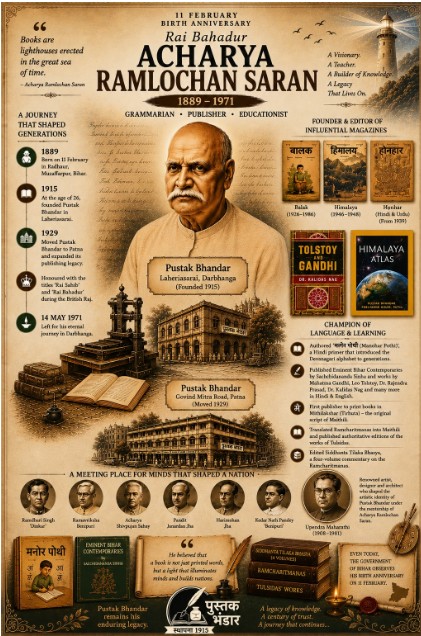
Pustak Bhandar: A House Built for Knowledge In 1915, Acharya Ramlochan Saran founded Pustak Bhandar at Laheriasarai, Darbhanga. What began as a publishing venture grew into an enduring institution of learning. Historical accounts describe him as a grammarian, educator, writer and publisher who helped give authors and readers a dependable literary platform. Publishing operations later expanded to Patna, but Laheriasarai remained foundational to the story. Pustak Bhandar was never merely a commercial press. It became a meeting place for ideas and a source of educational material for ordinary families. Through primers, magazines, literary works and cultural publications, it helped connect the classroom, the household and the wider intellectual life of Bihar and Mithila. Serving Maithili Through Print Acharya Ramlochan Saran is remembered for advancing the publication of Maithili and for helping bring works in Mithilakshar, the traditional script of Maithili, into print. This contribution matters profoundly. A language survives most securely when it can be read, taught, archived and passed from one generation to the next. Printing gave Maithili literature permanence, reach and a place in libraries beyond its homeland. Among the works closely associated with him is Maithili Shriramcharitmanas. The Saran family has long preserved the understanding that he produced the first Maithili translation of Tulsidas's Ramcharitmanas. Independent library catalogues confirm that a Maithili Shriramcharitmanas under the name Shri Ramlochan Saran remains held in institutional collections. The work made a revered spiritual text more directly accessible to Maithili-speaking readers and linked devotion with the dignity of the mother tongue. The Vidyapati Panchang: A Living Continuity The strongest proof of a legacy is not simply that it is remembered, but that it continues to serve. To this day, the Saran family continues the publication of the Vidyapati Panchang through Pustak Bhandar. Each annual edition represents much more than a calendar: it carries religious observances, traditional knowledge, seasonal rhythms and the cultural memory of Mithila into homes across generations. For the family, continuing this publication is both an honour and a duty. The printing press may have changed, distribution may have modernised and readers may now live across the world, but the purpose remains the same: to keep knowledge accessible and tradition alive. Beyond Books: Building Generations Acharya Ramlochan Saran's contribution extended beyond individual titles. He founded and supported periodicals, including the children's magazine Balak, and encouraged literary and artistic talent. His publishing world was connected with prominent figures of Bihar's intellectual life, helping create an environment in which education, literature, public service and cultural confidence could reinforce one another. His example carries a lesson for the present. Languages do not endure through nostalgia alone. They endure when children read them, families speak them, writers create in them, organisations celebrate them and publishers continue to place them before the public. Every book printed in Maithili is therefore more than a publication: it is an act of cultural preservation. Carrying the Lamp Forward Meeting Ravi Lochan in Australia made this inheritance feel immediate and alive. His own journey and the position he has built here demonstrate how the values of learning, service and cultural confidence can travel across continents. The work begun at Pustak Bhandar challenges all of us to introduce Maithili literature to younger generations, preserve rare publications, support contemporary writers and use digital platforms to take Mithila's knowledge to a global audience. Acharya Ramlochan Saran showed that one determined person, working through education and publishing, can shape the cultural life of generations. More than half a century after his passing, his legacy continues wherever a child opens a primer, a reader discovers Maithili literature, a family consults the Vidyapati Panchang, or a devotee encounters the Ramcharitmanas in the language of home. His enduring message is clear: when we preserve a language, we preserve a people's memory, identity and future. Honouring a Legacy Across Generations It was an honour to meet Ravi Lochan Ji and, through him, to understand more closely the extraordinary contribution of Acharya Ramlochan Saran. With reverence and gratitude, we remember Acharyaji not only as the founder of Pustak Bhandar, but as a builder of knowledge and a devoted servant of language. May his life continue to inspire everyone working for Maithili, Mithila and the preservation of India's literary traditions. Sources and editorial note Information shared in connection with the author's meeting with Ravi Lochan, including the continuing publication of the Vidyapati Panchang by the Saran family. Bihar Foundation, biographical remembrance of Acharya Ramlochan Saran (birth, publishing and Mithilakshar contribution). Indian Printer & Publisher, interview on Pustak Bhandar's publishing history (2022). Jnana Prabodhini Ramayana collection catalogue, listing Maithili Shriramcharitmanas by Shri Ramlochan Saran.